Don’t miss an episode. Get our podcast sent straight to your inbox every week.
Don’t miss an episode. Get our podcast sent straight to your inbox every week.
He grunted. That was the entire conversation.
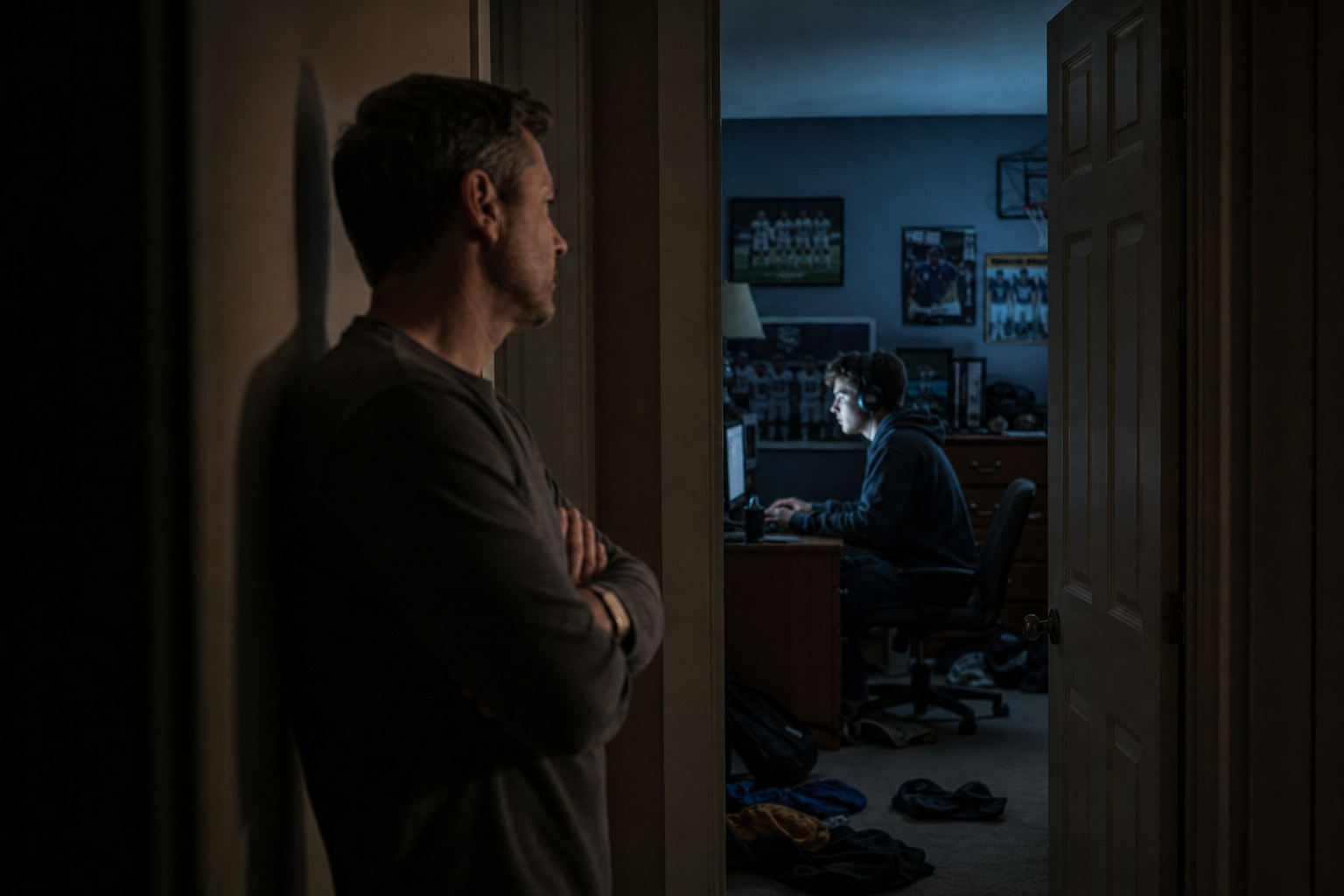
You asked how school went. "Fine." You asked about the game. "We lost." Then the bedroom door, the click of a headset going on, and you standing in the hallway of a house you paid for, locked out of a kid you would step in front of a truck for.
I'm Doug Holt. I've had this exact conversation with hundreds of married businessmen, usually about ten minutes after they've told me their marriage is the real problem. Sometimes it is. Often the thing actually eating them is a fifteen-year-old who used to follow them into the garage and now won't look up from a screen.
How do you connect with your teenage son when he won't talk? To connect with your teenage son when he won't talk, stop asking for verbal reports and focus on presence. Boys communicate sideways during activities like driving or working on projects rather than direct conversations. Practice Alpha Decompression to stay calm, use the Hidden Motives Technique to understand underlying fears, and create consistent low-pressure moments.
Why Won't My Teenage Son Talk to Me?
Because you're asking him to perform.
Every "how was your day" is a small test he can fail. He's just spent seven hours reading a room, managing a friend group, and keeping his face neutral in a hallway. He's out of gas. And you're standing in the kitchen asking for a report.
Then there's your track record. If the last four times he opened his mouth you gave him advice, a correction, or a story about how you handled it in 1998, he's learned exactly what a conversation with Dad costs. Boys are ruthless accountants about that. They don't announce the policy change. They just stop paying.
I did this in my own house for a stretch. I'd come home from a nine-hour day still running in CEO mode and try to manage my family like a stand-up meeting. Status. Blockers. Next steps. My son answered me the way anyone answers a boss he doesn't fully trust: minimum viable words, delivered on the way out of the room.
Sound familiar?
What Is My Teenage Son Protecting When He Goes Quiet?
Here's the tool that changes this fastest. The Hidden Motives Technique is a communication method designed to uncover the unstated fear or insecurity driving a person's defensive reaction, and it's one of the core methods we teach at The Powerful Man. The premise is simple. What a person says is rarely what a person means. Underneath the words there's a motive, usually protective, and if you argue with the words you never touch the motive.
"Leave me alone" almost never means leave me alone. Underneath it, with teenage boys, you're usually looking at shame or fear of your disappointment. He's behind in a class. He got cut. A girl said something. He's terrified you'll find out he isn't the version of himself he thinks you're expecting.
So he pre-empts. He closes the door before you can be disappointed in what's behind it.
When you learn to hear the motive, the temperature drops. You stop hearing disrespect and start hearing a kid guarding something. And you respond to the guarded thing, gently, without naming it. That's the whole move.
Why Does He Open Up to Everyone Except You?
Because his friends and his coach and his uncle don't have a plan for his life.
You do. He can feel it in the room. Every question you ask has a future attached to it, and he knows he's the one who has to carry that future. His buddy asking what he's doing this weekend costs him nothing. You asking what he's doing this weekend has a college in it somewhere.
This is why sideways connection works and face-to-face rarely does. Boys open up when their hands are busy and their eyes are pointed somewhere else. The truck. The garage. The dishes. Late at night when you're both tired and standing in the kitchen for no reason.
Here's what most married businessmen get wrong, and what to run instead.
What you're doing
What he hears
What to run instead
"How was your day?" at the door
A status report is due
Say nothing. Be in the room for ten minutes first
Asking questions across the dinner table
Direct evaluation, nowhere to look
Drive him somewhere. Any errand. No radio talk
Giving advice inside 60 seconds
This is a lecture with a question mark on it
Ask one follow-up question, then shut up
Fixing the problem for him
You don't think I can handle it
"That sounds hard. What are you thinking?"
Bringing it up again the next day
I'm a project he's managing
Let it sit. He'll circle back on his own timing
Waiting for a big talk
Nothing, because it never happens
Ten minutes a day beats two hours a month
Look at that last row. That's the one that gets fathers. You've been saving up for a real conversation, some weekend where you'll finally get into it. He doesn't need the summit. He needs a hundred low-stakes touches that teach his nervous system you're safe to be around.
What Should I Do in the First Ten Minutes I Get Home?
Nothing that involves your family. That's the honest answer.
Alpha Decompression is the evening protocol we run inside The Activation Method, and it exists because of a specific failure I watched happen in my own life and in the lives of nearly every man I coach. You drive home carrying the pressure of the day. You walk through the door still holding it. Then you touch the first person you love with hands that are still full.
Your son reads your state before you say a word. Boys are extremely good at this, because for most of human history reading the mood of the biggest man in the room was survival information. If you come in tight, he goes quiet. He isn't rejecting you. He's clearing the runway.
So you build a gap. Ten minutes in the car before you walk in. A walk around the block. A shower. Whatever moves you out of work mode and back into being a father. Then you enter the house as the man you actually want to be in it, and you say nothing important for the first ten minutes.
Most fathers I work with feel a shift inside two weeks with that one change. No new communication skills, no better questions. Just a different man walking through the door.
Where Does Fatherhood Sit in the Five Territories?
We teach the Five Territories at The Powerful Man because a man's life doesn't fail in one place at a time. Self, Health, Relationships, Wealth, Business. Your relationship with your son lives in Relationships, but it gets funded out of Self.
That's why "how do I talk to my son" is almost never a communication problem. A man who's exhausted, drinking too much on weeknights, and hasn't had an honest conversation with anyone in six months does not have the reserves to sit in silence next to a moody teenager and stay warm. He'll snap, or he'll withdraw and call it giving him space.
Fill the Self territory and the fathering gets easier without you working on the fathering. That connection surprises men every time.
What If He's Already Grown and Gone?
Then you're playing a longer game with the same rules, and I've watched men win it at 60.
Reach out with no ask attached. A text about something he cares about, not something you want him to do. Do it consistently for months without keeping score. If there's real damage back there, own your part cleanly and completely, without the sentence that starts with "but." The word "but" deletes everything in front of it.
Men in the Brotherhood have repaired relationships with sons who hadn't called in four years. It's slow. It works.
Common Questions About Connecting With Your Teenage Son
How long does it take before my teenage son starts opening up?
Most men notice initial shifts within three to six weeks of consistent, low-pressure presence. Forcing conversations earlier resets progress; allowing connection to happen sideways during shared activities builds natural long-term safety.
Should I let my teenage son be rude or quiet with me?
Address direct disrespect immediately and calmly in one simple sentence without escalating or arguing. Differentiate between quiet withdrawal and disrespect; hold boundaries on tone while allowing him space to process.
Is my wife responsible for managing our son's emotional needs?
Outsourcing emotional parenting to your wife strains the marriage and deepens father-son distance. Taking direct, regulated responsibility for your relationship with your son restores family balance and relieves pressure on your wife.
How do I handle video games and screen time without fighting?
Engage in his digital world directly without making his interests the enemy. Establish reasonable family boundaries around screen time while using gaming or shared media as low-stakes opportunities for sideways connection.
What should I do if I lose my temper with my son?
Rebuild trust through prompt, calm accountability. Return to him, take ownership of your loss of temper without making excuses or blaming his behavior, and demonstrate steady, regulated leadership moving forward.
Start Tonight
Tonight, when you get home, don't ask him anything.
Sit in the same room. Ten minutes. Say one thing that isn't a question and doesn't require a response. Then get up and go do something else, and do it again tomorrow.
That's it. That's the whole first week.
If you want the full system, with coaching and a room full of married businessmen doing this same work on their marriages and their kids, that's The Activation Method, our eight-week program. Men who go all the way in earn their place at The Alpha Reset, and from there into the Brotherhood.
As always, I'm in your corner.
Doug Holt is the founder of The Powerful Man, a global coaching company that helps married businessmen reconnect with their wives and families without giving up success in business. Through programs like The Activation Method and The Alpha Reset, Doug and his team have worked with men in more than 100 countries to build lives worth coming home to.