Don’t miss an episode. Get our podcast sent straight to your inbox every week.
Don’t miss an episode. Get our podcast sent straight to your inbox every week.
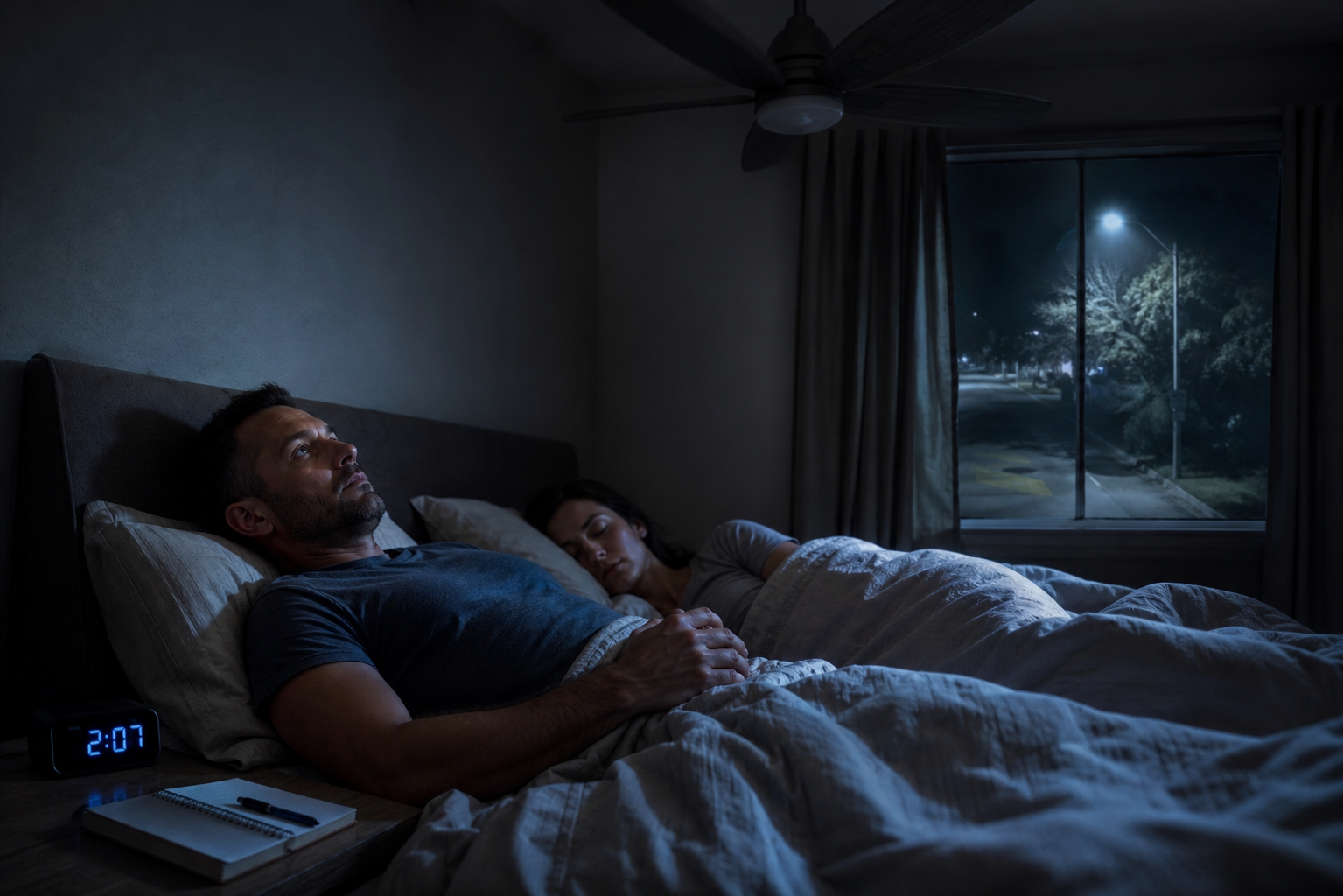
It’s 2:07 a.m. You’re staring at the ceiling fan. Your wife is breathing slow and even next to you, and your brain is running the Thursday sales call, the payroll number, the thing you said to your son at dinner, and whether the furnace guy ever called back.
You’re exhausted. You are also wide awake. Sound familiar?
The short answer
To stop overthinking at night and fall asleep, close unfiled workday loops before dinner and establish a structured transition ritual. High-performing men must write down open tasks, apply Alpha Decompression to lower cortisol, cut alcohol three hours before bed, and restore personal capacity through systematic tools inside The Activation Method.
Doug Holt, founder of The Powerful Man, teaches married businessmen to stop overthinking at night by fixing the handoff between the workday and the bedroom. Racing thoughts at 2 a.m. are usually unfinished business your brain refuses to file. Most men try to think their way to sleep. That fails. You have to complete the day, then let your body take over.
The Activation Method is an 8-week system designed specifically for married businessmen to rebuild their personal capacity, clear marital backlogs, and lead their relationships with calm certainty.
Why does my brain start racing the second I lie down?
Because lying down is the first quiet moment you’ve had since 6 a.m.
All day you ran on noise: calls, texts, kids, a calendar with no white space. The moment you stop, everything you shoved aside comes back for a meeting. Your brain has no phone to check, so it checks itself.
There’s a second piece. If you carry your stress home and keep it running through dinner, your body is still in work mode at 10 p.m. Elevated stress hormones and a quiet bedroom don’t mix. You’re wired, and you’re tired, and those two things fight each other until 3 a.m.
I lived on this loop for about two years. I’d fall asleep fine, then pop awake at 2:30 with a full agenda. (My wife eventually started calling it “the board meeting.” She wasn’t wrong.) What finally worked wasn’t a supplement. It was a different end to the day.
What's actually keeping you up?
Not every sleepless night has the same cause, so treat it like a diagnosis. Here’s how the most common patterns look.
What you notice
Likely cause
First fix
Can't fall asleep, mind replays the workday
Open loops and no transition
Brain dump on paper before dinner
Fall asleep fast, wake at 2 to 3 a.m.
Alcohol wearing off, or stress spike
Cut drinks 3 hours before bed
Fall asleep, wake tired anyway
Phone and light late at night
Charge the phone outside the bedroom
Lie there worrying about money or the marriage
An unresolved conversation
Schedule the talk, then write it down
Find your row. Most men I coach are in at least two of them.
How do you turn off your brain before bed?
Empty it onto paper. Your head is a terrible filing cabinet, and it keeps reopening drawers because it doesn’t trust you’ll handle what’s inside.
Try this. About an hour before bed, take five minutes and write down everything still running: tasks, worries, conversations you owe someone. Next to each item, write the very next physical action, even if that action is “text Mike at 9.” Then close the notebook.
That last part matters. You’re telling your brain the item is captured and scheduled, so it can stop guarding it. I’ve watched men who swore they were “just wired that way” sleep through the night within a week of doing this. It looks almost too simple. Do it anyway.
And put the notebook on the nightstand. If a thought wakes you at 2 a.m., write one line and go back to sleep. Don’t get up and open the laptop. Ever.
What does Alpha Decompression have to do with sleep?
Everything, and it’s the piece married businessmen skip.
Alpha Decompression is the routine we teach at The Powerful Man to move you out of work mode before you walk into family mode. We teach it inside The Activation Method. Ten minutes when you get home, or in the car before you go in. No phone. Slow breathing, a quick review of the day’s wins, and one deliberate decision: work is done.
Here’s why it protects your sleep. If you walk in the door still mentally answering email, your nervous system never comes down. You spend the whole evening at a low boil, your wife reads it, the kids read it, and by bedtime you’re carrying the workday and a slightly tense house. Decompression lets the day end at 6 p.m. instead of midnight.
Pair it with Alpha Rise & Shine in the morning. A steady wake time, sunlight and some movement early in the day anchor your body clock, which makes falling asleep at night far easier. Your evening routine and your morning routine are one system. Most men fix the wrong half.
Is the drink helping you sleep or wrecking it?
Wrecking it. Sorry, brother.
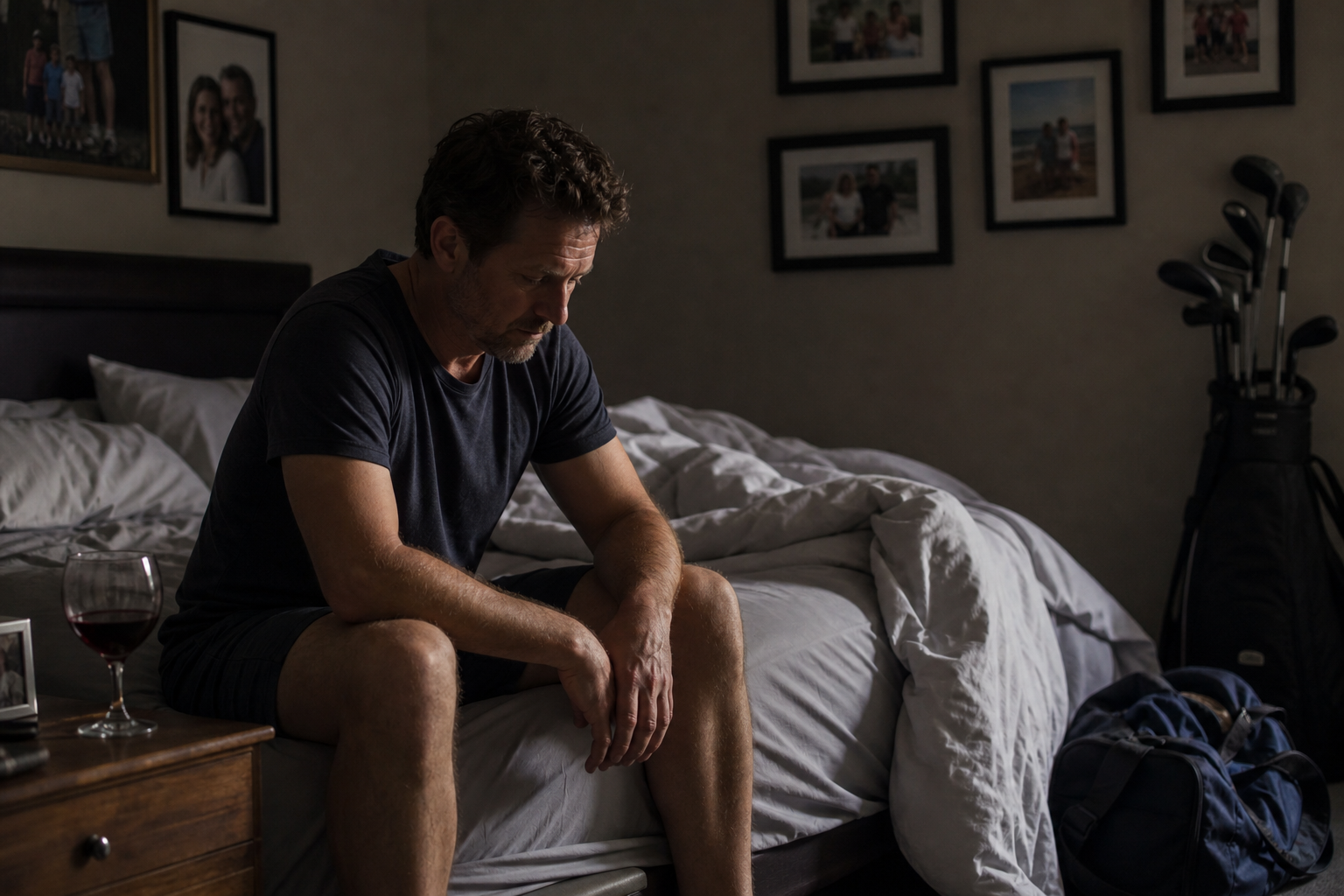
Alcohol feels like a sedative. You get sleepy, you pass out. But it fragments your sleep later in the night, cuts into REM, and is a very common reason men wake at 2 or 3 a.m. with their heart going. That’s not a discipline problem. It’s chemistry.
Here’s the test: for two weeks, stop drinking at least three hours before bed. Two weeks, no exceptions, and track how you wake up. If you feel dramatically better, you have your answer. If you struggle to make it two weeks, that’s information too, and worth a hard look. I’ve done both versions of this experiment on myself.
What should the last hour of your night look like?
Boring. Deliberately, gloriously boring.
Dim the lights an hour out. Phone charges in the kitchen, not next to your head. The CDC recommends adults get at least seven hours of sleep, and you can’t hit that number by scrolling until 11:40 and setting a 5:30 alarm.
Then build a simple wind-down you repeat every night:
Brain dump and next actions (5 minutes)
Shower or wash up, then stretch on the floor (5 minutes)
Read paper pages, not a screen, until your eyes get heavy
Lights out within the same 20-minute window every night
Keep it the same every night. Your body learns the sequence like a bedtime story, and the sequence starts doing the work for you.
If you and your wife have unresolved tension, do not try to fix it in bed at 10:45. Say “I want to talk about this Saturday morning, and I’ll bring coffee.” Then write it on your list. Half of nighttime overthinking is an argument you’re rehearsing.
When is it more than stress?
Some of it is medical. Loud snoring, gasping, waking unrefreshed after eight hours, or daytime sleepiness that follows you into meetings can point to sleep apnea, and that needs a doctor, not a routine. Same for low testosterone or thyroid issues. If you’ve done four weeks of the steps above and nothing has moved, get bloodwork and a sleep evaluation. I’m a coach, not your physician, and I’d rather you get checked than white-knuckle it.
Where does sleep fit in the Five Territories?
The Five Territories framework is a capacity management model for married businessmen to evaluate and balance Self, Health, Relationships, Wealth, and Business.
Sleep sits in Health, but it leaks into every territory. Bad sleep shortens your fuse at home (Relationships), clouds your decisions (Business) and makes the gym feel impossible (Health). Watch how quickly a single good week of sleep lifts the other four.
Use The Flip here. Instead of asking “how do I fit sleep around everything I have to do,” ask “what has to move so I can protect eight hours.” Your calendar will survive a 9:30 p.m. cutoff on email. Your body won’t survive another five years without one.
FAQ
Why do I wake up at 3 a.m. and can’t fall back asleep?
The usual suspects are alcohol wearing off, a stress-hormone spike, or a mind full of unfiled tasks. Keep a notebook by the bed, write one line, and keep the lights low. Avoid checking the clock or your phone.
How long does it take to stop overthinking at night?
Most men I coach notice a difference within one to two weeks of a consistent brain dump and wind-down. Deeper patterns, like chronic work stress, take longer and usually need the daily decompression habit to hold.
Is it normal for busy business owners to sleep badly?
It’s common, but common isn’t the same as fine. Six hours a night for years costs you patience with your family and sharpness at work, and you rarely notice the cost until it’s large.
Should I take melatonin or a sleep aid?
Talk to your doctor about that. A pill can’t cover for a nervous system that never got the message the day ended, so fix the routine first.
What is the fastest way to stop overthinking when I am lying in bed?
Get out of your head and onto paper. Keep a notebook on your nightstand, write down the single thought or task keeping you awake alongside your next physical action step, and close the cover. Do not open your phone or laptop.
What Is the First Step to Take When You Cannot Stop Overthinking at Night?
Tonight, do one thing: write your open loops on paper an hour before bed. Just that. Tomorrow, add ten minutes of decompression when you walk in the door.
If you’re a man who wins at work and pays for it at 2 a.m., The Powerful Man built The Activation Method for you. It’s eight weeks of live coaching with Doug Holt or a Master Coach, and it installs the daily routines that make rest possible. Men who finish it and want more earn a seat at The Alpha Reset, and from there the Brotherhood.
You built a lot. You deserve to sleep inside it.
As always, I’m in your corner.
About the author
Doug Holt is the founder of The Powerful Man, a global coaching organization for married businessmen who are winning at work and losing at home. Through The Activation Method, The Alpha Reset and the Brotherhood, Doug Holt and his team have worked with men across more than 30 countries to rebuild their marriages and their health without asking them to give up the businesses they built.