Don’t miss an episode. Get our podcast sent straight to your inbox every week.
Don’t miss an episode. Get our podcast sent straight to your inbox every week.
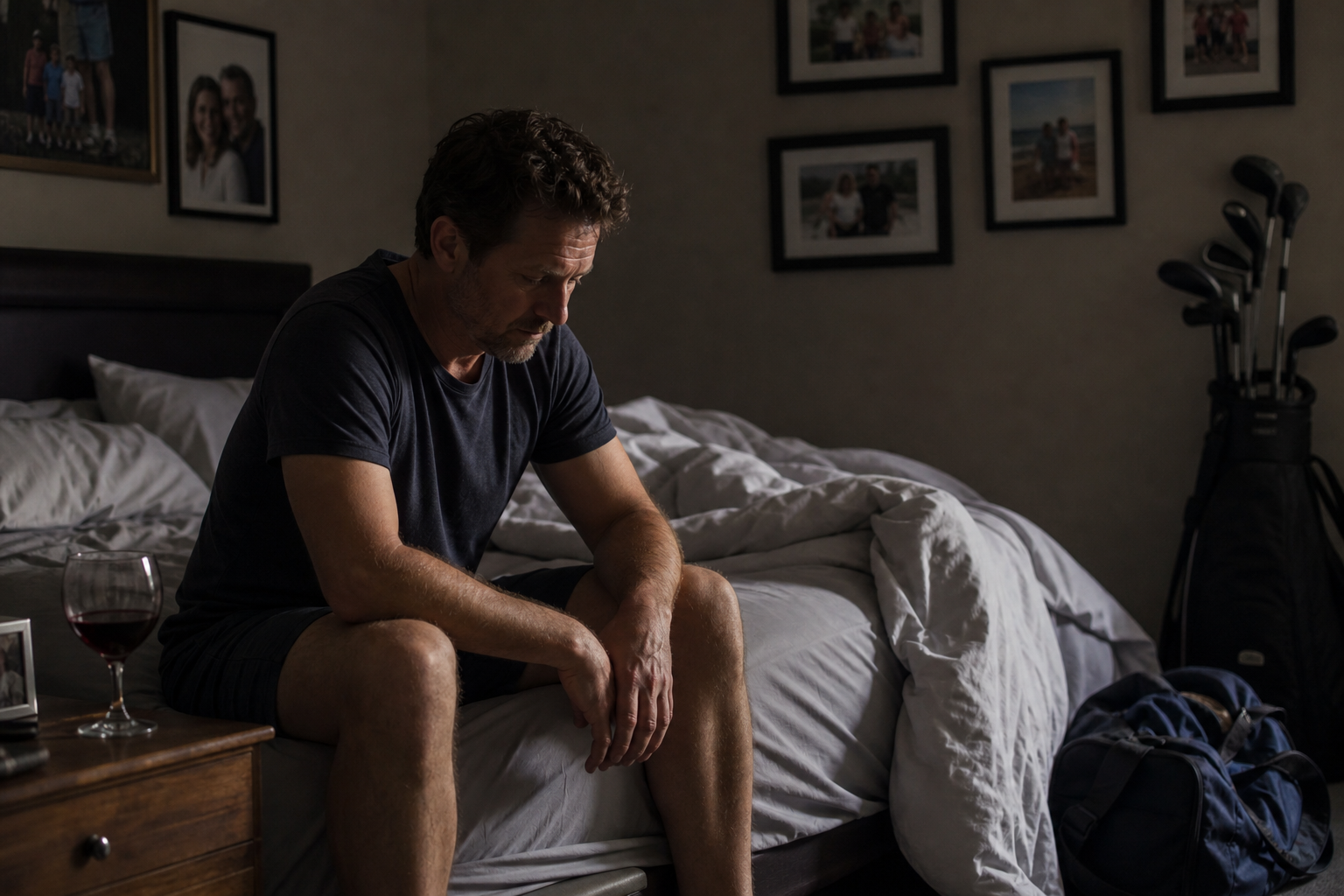
You haven’t touched the gym bag in three weeks. It’s still sitting in the trunk, next to the golf clubs you also haven’t touched.
Your wife asked last night if something’s wrong, and you said you’re just tired. You’ve been saying that for four months.
The waistband that fit fine at your last physical doesn’t fit now, and you haven’t changed a single thing about how you eat. You don’t want sex the way you used to, and you’d rather not think about why.
Nobody handed you a diagnosis. You just quietly became a lower-voltage version of the man who built this business, and you assumed that’s what forty does to a guy.
It isn’t. Not automatically.
The short answer
To address low testosterone symptoms in men over 40, fix lifestyle inputs first and restore personal capacity. High-performing men must establish a transition ritual using Alpha Decompression, reset their circadian rhythm with Alpha Rise & Shine, lift heavy weights consistently, and rebuild health capacity using systematic tools inside The Activation Method.
Doug Holt, founder of The Powerful Man, sees this exact man in nearly every group that goes through The Activation Method: successful, still providing, running on maybe sixty percent of the drive he had at thirty. Low testosterone in men over 40 rarely announces itself. It shows up as a personality change nobody names correctly. The gym motivation goes first. Then the patience. Then the marriage bed. Some of the decline is age, and some of it is a life stacked with stress, bad sleep, and a body that hasn’t lifted anything heavy since college. The Activation Method is an 8-week system designed specifically for married businessmen to rebuild their personal capacity, clear marital backlogs, and lead their relationships with calm certainty.
At The Powerful Man, we treat this as a Health Territory problem first within the Five Territories framework, because a low-T man can’t show up for Relationships or Business the way he wants to either. The Five Territories framework is a capacity management model for married businessmen to evaluate and balance Self, Health, Relationships, Wealth, and Business.
What are the actual signs of low testosterone in a man over 40?
Forget the drug commercial checklist. Here’s what it looks like on an ordinary Tuesday.
What shows up
What you probably blame it on
Gym motivation gone, strength dropping even on the days you show up
Getting older, being busy
Weight gain around the belly with no real change in diet
Slowing metabolism
Wanting sex less, or wanting it and the body not fully cooperating
Stress, a long day
Snapping at your kids or your wife over nothing
Being overworked
Brain fog in the 2 p.m. meeting you used to run sharp
Not enough coffee
Flat mood, flat drive, nothing feels the way it used to
Midlife, or "just how it is now"
Read the right column again. Every excuse in it is reasonable by itself. Stack five or six of them for a year and reasonable stops being the honest word.
Sound familiar?
Why does testosterone drop right when your business and marriage need you most?
Bad timing, mostly.
Total testosterone falls by roughly one percent a year starting sometime in your thirties. That figure comes from the Baltimore Longitudinal Study of Aging, research led by S. Mitchell Harman and published in the Journal of Clinical Endocrinology and Metabolism in 2001. One percent a year sounds survivable. Compound it for fifteen years while you’re also running a company, and it stops being just biology.
Cortisol is the accelerant. Your body treats a tense board call and an actual threat with roughly the same chemistry, and cortisol competes with testosterone for the same raw material and the same attention from your brain. Run hot on stress hormones from six a.m. to midnight, which is exactly what most married businessmen do, and testosterone gets whatever’s left over.
I ran that exact cycle for years. Tense calls until six, a glass of wine by eight, and I couldn’t figure out why my energy fell off a cliff somewhere around forty-three. Nobody told me cortisol was quietly eating my testosterone the whole time. I learned it the hard way, then built Alpha Decompression so the men in The Activation Method wouldn’t have to.
Sleep does the rest of the damage. Most of a man’s daily testosterone production happens during deep sleep, and five broken hours a night doesn’t leave much time on the factory floor. Add the second glass of wine that quietly became a nightly habit (alcohol suppresses testosterone directly), and you’ve built a machine that runs your hormones down faster than forty would on its own.
This is exactly why Alpha Decompression exists inside The Activation Method. A hard stop between the version of you that just closed a tense call and the version of you that walks in your front door. Two minutes in the driveway before you go inside. Shoulders down, jaw unclenched, cortisol told the workday actually ended. Skip that for ten years and your hormones notice.
Is it really low testosterone, or is it just stress and bad sleep?
Usually both, and the split matters less than you’d think.
The European Male Ageing Study, led by Frederick Wu and published in The New England Journal of Medicine in 2010, tracked more than three thousand men across eight countries and landed on something specific: a testosterone problem worth treating combines low blood levels with a persistent cluster of symptoms, mainly low libido, weaker morning erections, and low energy. A single rough week doesn’t count. That’s the actual bar. Not a feeling. Two morning blood draws and an honest look at the symptom list.
Here’s the part men don’t want to hear. Sleep five hours, drink four nights a week, skip the gym, and run stressed out of your mind, and your testosterone will read low even if nothing’s medically wrong with you. Fix the inputs first. Some men fix the inputs and the number comes back on its own. Some men fix every input for six months straight, the number’s still low, and that’s a real conversation with a doctor about testosterone replacement therapy, done properly, with monitoring, not a protocol some guy at your gym is selling.
What actually moves the needle?
At The Powerful Man, we treat this like a business problem: measure it, then fix the inputs, in order.
Lift heavy, three times a week, non-negotiable. Squats, deadlifts, presses. This alone moves testosterone more than anything you’ll buy off an 11 p.m. Instagram ad.
Fix your sleep window before you fix your supplements. Same wake time every day, weekends included. This is the whole idea behind Alpha Rise & Shine, The Powerful Man’s morning framework: sunlight, movement, and a fixed wake time reset the same hormonal clock testosterone runs on.
Cut the nightly drink to twice a week. Not zero forever. Twice.
Get an actual morning blood panel, total and free testosterone, drawn before ten a.m. Not a symptom quiz on a supplement website.
Run Alpha Decompression on every day that included a hard call, so cortisol doesn’t camp out in your bloodstream until midnight.
Run those five for eight weeks before you decide what kind of problem you actually have.
Myth
What's actually true
TRT is the first move
Real medical guidance treats it as a later step, after the lifestyle inputs are fixed and two morning labs confirm it
It's just aging, nothing to do about it
Aging is part of it. Sleep, training, and stress are the other part, and those three are yours to control
Low libido means the marriage is failing
Often the biology is talking first. The marriage strain follows if the biology gets ignored
Supplements will fix it
Most over-the-counter test boosters carry little independent evidence. Sleep and heavy lifting outperform them
Frequently asked questions
Can stress alone cause low testosterone, or is it always aging?
Usually both. Chronic cortisol suppresses production on its own, and testosterone falls with age regardless of stress. Sorting out which one is doing more requires an actual blood panel, not a guess at 11 p.m.
What’s a normal testosterone level for a man in his 40s?
Ranges vary by lab, and most flag total testosterone under roughly 300 ng/dL as low. But the European Male Ageing Study standard requires the symptom cluster alongside the number. A single lab value isn’t the whole answer, and that conversation belongs with your doctor and your actual panel.
Does losing weight and lifting really raise testosterone naturally?
Yes, meaningfully, for a lot of men. Belly fat converts testosterone into estrogen, so losing it directly changes the hormonal math, on top of whatever heavy lifting does for production on its own.
Is testosterone replacement therapy safe?
For the right man, with real labs and a physician who monitors him, generally yes. It isn’t something to start off a symptom quiz or a buddy’s protocol. Get the labs. Get a doctor who actually watches your numbers over time.
How long before lifestyle changes affect the symptoms?
Most men who fix sleep, training, and drinking notice a real difference in energy and drive within six to eight weeks. A full blood panel recheck usually waits closer to three months.
What Is the First Step to Take When You Have Low Testosterone Symptoms?
Start with a morning blood panel, then run the five inputs above for eight weeks. If the gym bag’s still sitting in the trunk, that’s not a character flaw. It’s a signal, and you’ve spent your whole career trained to ignore any signal that doesn’t come with a dollar sign attached.
The Activation Method is where married businessmen learn to run the Health Territory the same way they run the Business Territory: real numbers, a real plan, zero tolerance for excuses that used to work. Alpha Rise & Shine gets your mornings back. Alpha Decompression gets your evenings back. Men who want to keep building after those eight weeks earn their way into The Alpha Reset, and from there, the Brotherhood. Doug Holt and the coaching team have walked hundreds of married businessmen through exactly this rebuild, one blood panel and one honest gym session at a time.
If you are ready to evaluate where your capacity is slipping across all five territories, use The Powerful Man’s Find the Right Path application today to pinpoint where your leadership and energy are breaking down.
As always, I’m in your corner.
About the author
Doug Holt is the founder of The Powerful Man, a global coaching organization for married businessmen who are winning at work and losing at home. Through The Activation Method, The Alpha Reset and the Brotherhood, Doug Holt and his team have worked with men across more than 30 countries to rebuild their marriages and their health without asking them to give up the businesses they built.