Don’t miss an episode. Get our podcast sent straight to your inbox every week.
Don’t miss an episode. Get our podcast sent straight to your inbox every week.
If you're wondering whether your wife is still attracted to you, you're probably noticing that something feels different.
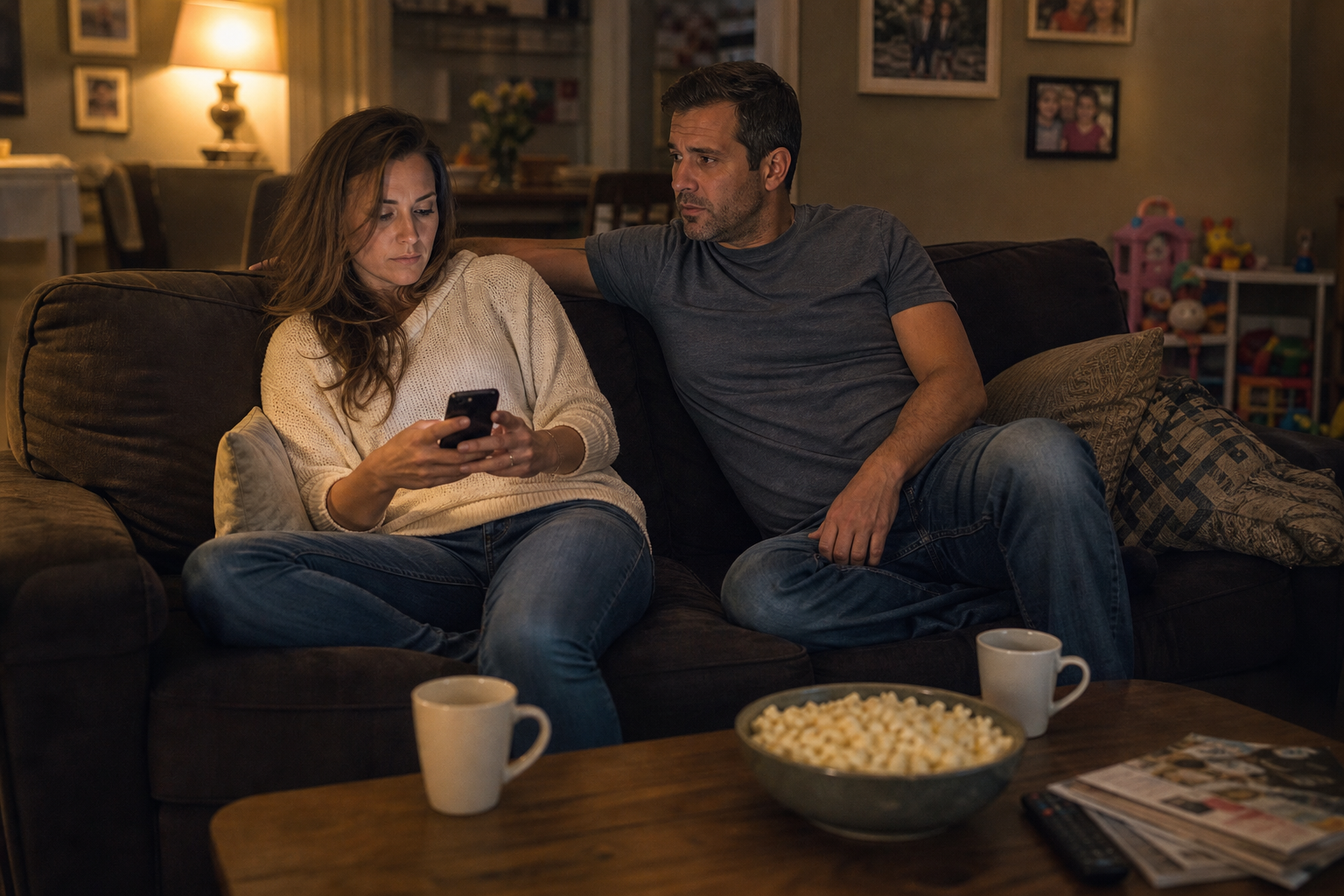
Maybe there's less flirting. Less physical affection. Less sexual energy between you. Perhaps you feel loved, but not particularly wanted.
Those changes can be signs that attraction has shifted, but no single behavior proves your wife is no longer attracted to you.
That's important.
A marriage can go through periods of stress, exhaustion, distraction, or disconnection that affect how attraction gets expressed. So rather than taking one rejected advance or a quiet week and concluding, "Well, that's it. She finds me repulsive," look at the broader pattern between you.
Here are some of the changes worth paying attention to.
1. The Flirting Between You Has Disappeared
Think back to when your relationship was new.
There were probably looks, jokes, teasing, compliments, little touches, and moments when neither of you needed to explicitly announce what was happening.
There was energy between you.
In a long-term marriage, some of that naturally changes. You have considerably more practical things to discuss than you did when you were dating.
But if flirtation has disappeared completely, that may be worth noticing.
Maybe conversations now revolve almost entirely around work, kids, bills, schedules, chores, and who's picking up what from where.
You're functioning as a team.
But are you still interacting as two people who are attracted to each other?
That's a different question.
2. Physical Affection Has Become Less Frequent
Physical connection isn't limited to sex.
It includes the small stuff too.
Touching as you walk past each other. Sitting close. Kissing. Hugging. Reaching for each other without needing the interaction to go anywhere.
If that kind of contact has noticeably decreased, it can contribute to the feeling that attraction between you has changed.
Again, context matters.
One evening when your wife doesn't want to cuddle isn't a diagnosis of your marriage.
You're looking for patterns, not collecting evidence for a prosecution.
The useful question is whether physical affection has become consistently less present in the relationship compared with what was normal for the two of you.
3. You Rarely Feel Desired Anymore
There's a difference between feeling loved and feeling desired.
Your wife might still care about you deeply. She might appreciate you as a husband, trust you, enjoy your company, and value the life you've built together.
Yet you can still feel that something is missing.
Maybe she rarely compliments you in an attracted way. Maybe you don't catch that look from her anymore. Maybe there's little sense that she's physically drawn toward you.
That doesn't automatically mean the love has disappeared.
It may mean that affection and attraction are no longer showing up in the same way.
This distinction is important because romance, love, and seduction aren't interchangeable. If you're unclear on that difference, our broader guide to seduction vs. romance and what seduction means in a relationship explains why a loving marriage can still experience changes in desire.
4. Sexual Energy Between You Has Changed
A change in your sexual relationship is understandably one of the first things you might notice.
Maybe sex happens less frequently. Maybe initiation feels increasingly one-sided. Perhaps there's less anticipation or playfulness around it than there used to be.
Those changes are worth paying attention to.
But be careful about turning frequency alone into a verdict on attraction.
Sexual behavior exists inside the rest of the relationship and the rest of life. A change tells you that something has changed. It doesn't necessarily tell you why.
That's an important distinction because the moment you decide you already know the explanation, you can stop being curious about what's actually happening.
5. Playfulness Has Been Replaced by Logistics
There is a particular kind of romance involved in asking:
"Did you pay the electricity bill?"
Sadly, it's not usually the kind that creates sexual tension.
Long-term relationships require logistics. Someone has to manage schedules, responsibilities, children, groceries, finances, and the mysterious household objects that apparently replenish themselves until suddenly they don't.
The problem isn't having practical conversations.
It's when practical conversations become almost the only conversations.
If teasing, joking, flirting, spontaneity, and playful attention have largely disappeared, your marriage can start feeling more functional than romantic or seductive.
You may still be an effective partnership.
But attraction doesn't necessarily thrive on administrative efficiency alone.
6. You Feel More Like Teammates or Roommates Than Lovers
This is often less about one specific behavior and more about the overall feel of the relationship.
You cooperate.
You get things done.
You raise the kids.
You handle responsibilities.
Maybe you even get along reasonably well.
Yet underneath all of that, you feel more like teammates, friends, or roommates than husband and wife — what TPM calls Roommates With a Ring.
That feeling doesn't prove your wife has stopped being attracted to you.
But it's worth taking seriously because a relationship can contain comfort, loyalty, and affection while leaving less room for visible desire.
The question isn't simply:
"Does she still love me?"
It may also be:
"Do we still experience ourselves as lovers, or have we become almost entirely partners in running a life?"
Those are different questions.
7. The Change Is a Pattern, Not an Isolated Moment
This may be the most important sign to pay attention to.
Don't diagnose your entire marriage from individual moments.
She didn't respond to your flirting tonight.
She wasn't interested in sex yesterday.
She seemed distracted during dinner.
Any one of those things can happen in a perfectly healthy marriage.
Instead, look at the overall direction.
Has flirting declined over time?
Has affectionate touch become unusual?
Has sexual energy noticeably changed?
Has the relationship become increasingly practical and less playful?
Do you consistently feel loved but rarely desired?
A repeated combination of changes tells you much more than any single incident.
Even then, it should be treated as a reason to become curious about your relationship, not proof that you've correctly diagnosed your wife's feelings.
Signs Are Not Proof
If you've recognized several things on this list, resist the temptation to turn them into a dramatic conclusion.
Attraction is only one possible part of what may be happening between you.
The supplied material for this article does not support claiming that a particular behavior proves your wife has lost attraction, nor does it support assigning a specific cause based on these signs alone.
So don't mind-read.
Don't assume that less sex automatically means she finds you unattractive.
Don't assume a lack of flirting means the marriage is dead.
And definitely don't start running secret experiments to see whether your wife "passes."
What you can do is notice the pattern honestly.
If something has changed, acknowledging it gives you a much better starting point than pretending everything is fine or immediately assuming the worst.
What Should You Do If You Think Your Wife Isn't Attracted to You?
First, separate what you've observed from what you've concluded.
"We've barely touched each other lately" is an observation.
"She isn't attracted to me anymore" is an interpretation.
That distinction can keep you from responding to a fear as though it's already a confirmed fact.
From there, the bigger questions become why the dynamic between you may have changed and what, if anything, needs to change next. If what you're really noticing is emotional distance rather than physical distance, it can help to work through what to do when your wife feels checked out.
Those are separate conversations.
The causes of fading attraction deserve more than a quick paragraph attached to a list of signs. So does the process of rebuilding attraction in a marriage.
For now, the important thing is to recognize whether you're reacting to an isolated moment or noticing a meaningful pattern.
Frequently Asked Questions
Can your wife love you but not feel attracted to you?
Love and attraction are connected, but they aren't identical. A marriage can contain affection, loyalty, companionship, and care while the amount of visible flirtation, sexual tension, or desire between partners changes.
Does less sex mean my wife isn't attracted to me?
Not necessarily. A change in your sexual relationship can be worth noticing, but frequency alone does not establish why the change has happened. Look at the broader pattern rather than using one measure as proof of what your wife feels.
What is the biggest sign your wife is losing attraction?
There isn't one behavior that reliably proves it. A broader pattern of reduced flirtation, affectionate touch, sexual energy, playfulness, and expressions of desire is more meaningful than any isolated event. Even then, those observations shouldn't be treated as proof of what your wife is thinking or feeling.